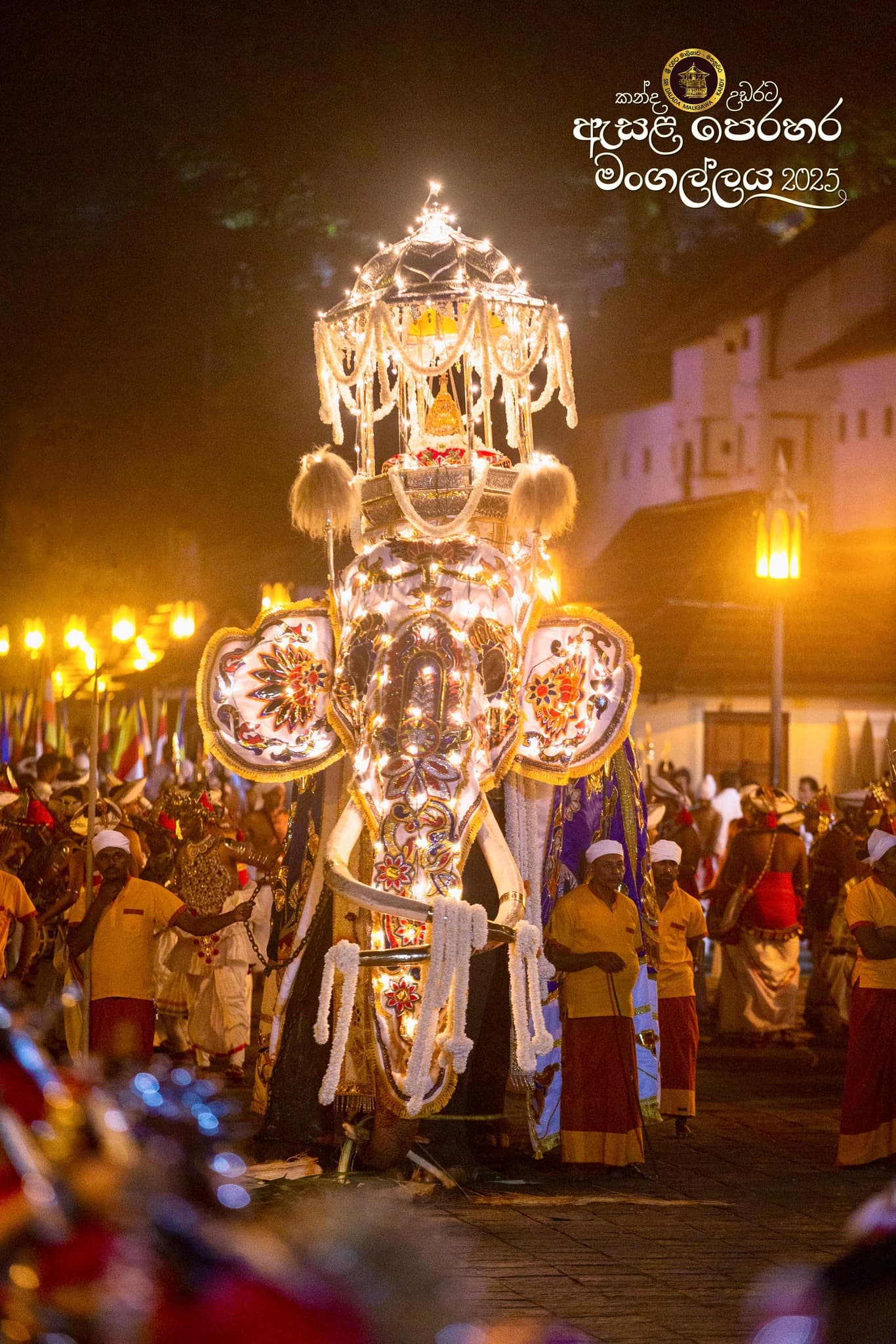
Every August, the ancient city of Kandy stops being a city. For ten consecutive nights, it becomes something older — a living act of devotion that has repeated itself, without interruption, for over fifteen centuries.
What You Are Witnessing
The Perahera — the word simply means "procession" in Sinhala — is the annual festival of the Temple of the Sacred Tooth Relic in Kandy. It is held every year in the month of Esala, corresponding roughly to July or August, and it runs for ten consecutive nights, building in scale and spectacle toward a final grand procession that is, by any measure, one of the most extraordinary things a human being can watch.
At its heart is an act of devotion: the ceremonial parading of a golden casket — a replica of the one that holds the Buddha's tooth relic — through the streets of Kandy, carried on the back of the Maligawa Tusker, the most sacred elephant in Sri Lanka.
But to describe it only in those terms is to describe the ocean as water.
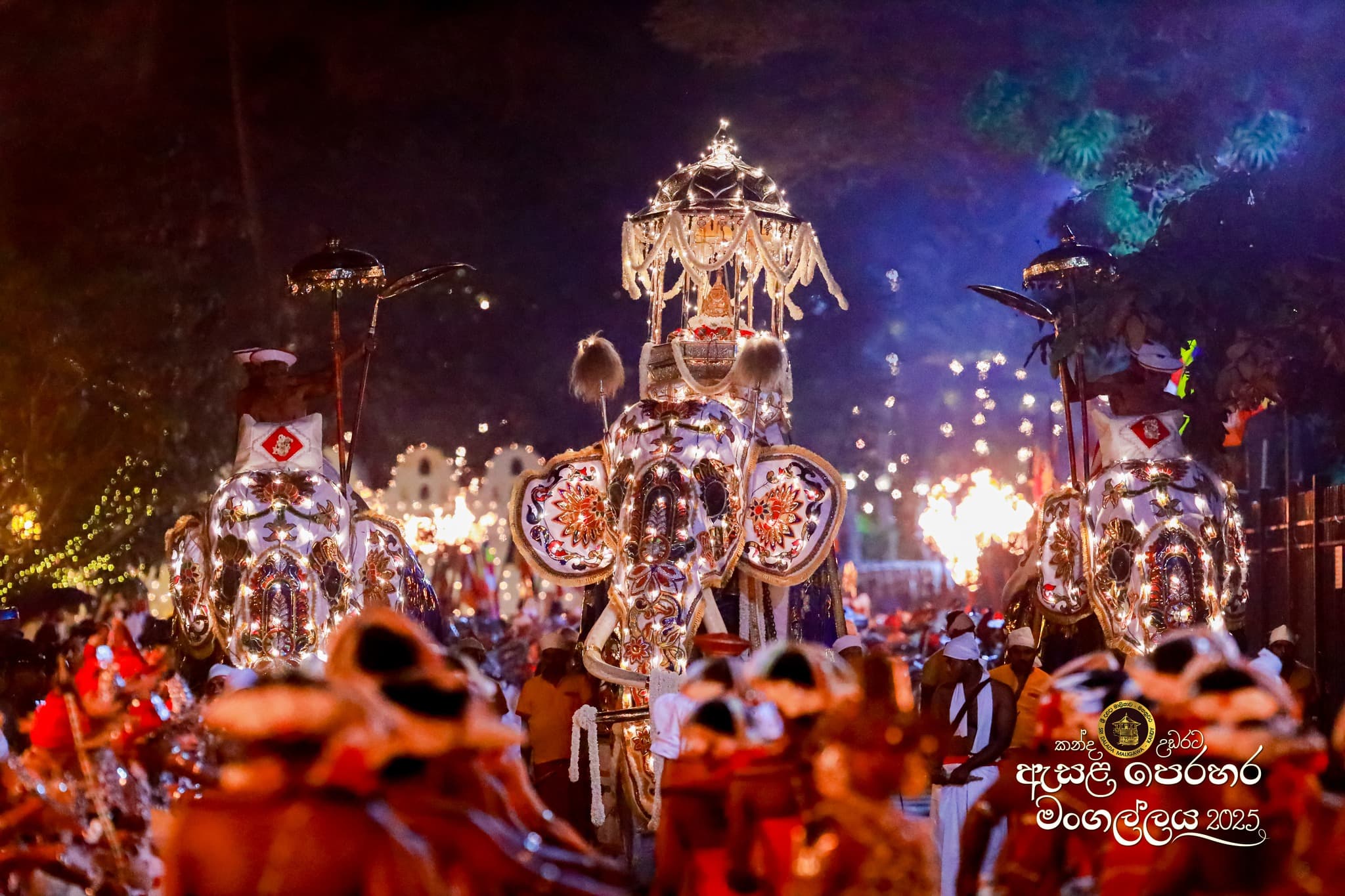
The Perahera procession at its peak — over 100 elephants, thousands of performers, and a city transformed by firelight.
Photo: Sri Dalada Maligawa Facebook Page
The Procession Itself
What moves through Kandy on those ten nights is not a parade in any sense a Western visitor would recognize. It is closer to a river — continuous, overwhelming, impossible to take in all at once.
It begins with whip-crackers — men who snap long leather whips in rhythmic unison, the sound splitting the air like gunshots, announcing that the procession is coming. Behind them come the torch-bearers, carrying massive traditional oil torches that bathe the streets in amber light no electric bulb can replicate.
Then the Kandyan dancers — and this is where time stops.
Dressed in elaborate silver-and-white costumes that take hours to assemble, they move with a precision that comes from years of training in a dance form with over three thousand years of lineage. The footwork is violent and exact. The leaps are genuinely gravity-defying. The expressions are not performance — they are possession.
Following the dancers come the drummers, playing the Geta Beraya — the traditional Kandyan drum — in rhythms that are not written down anywhere because they have been passed from teacher to student, body to body, for centuries.
And then, the elephants.
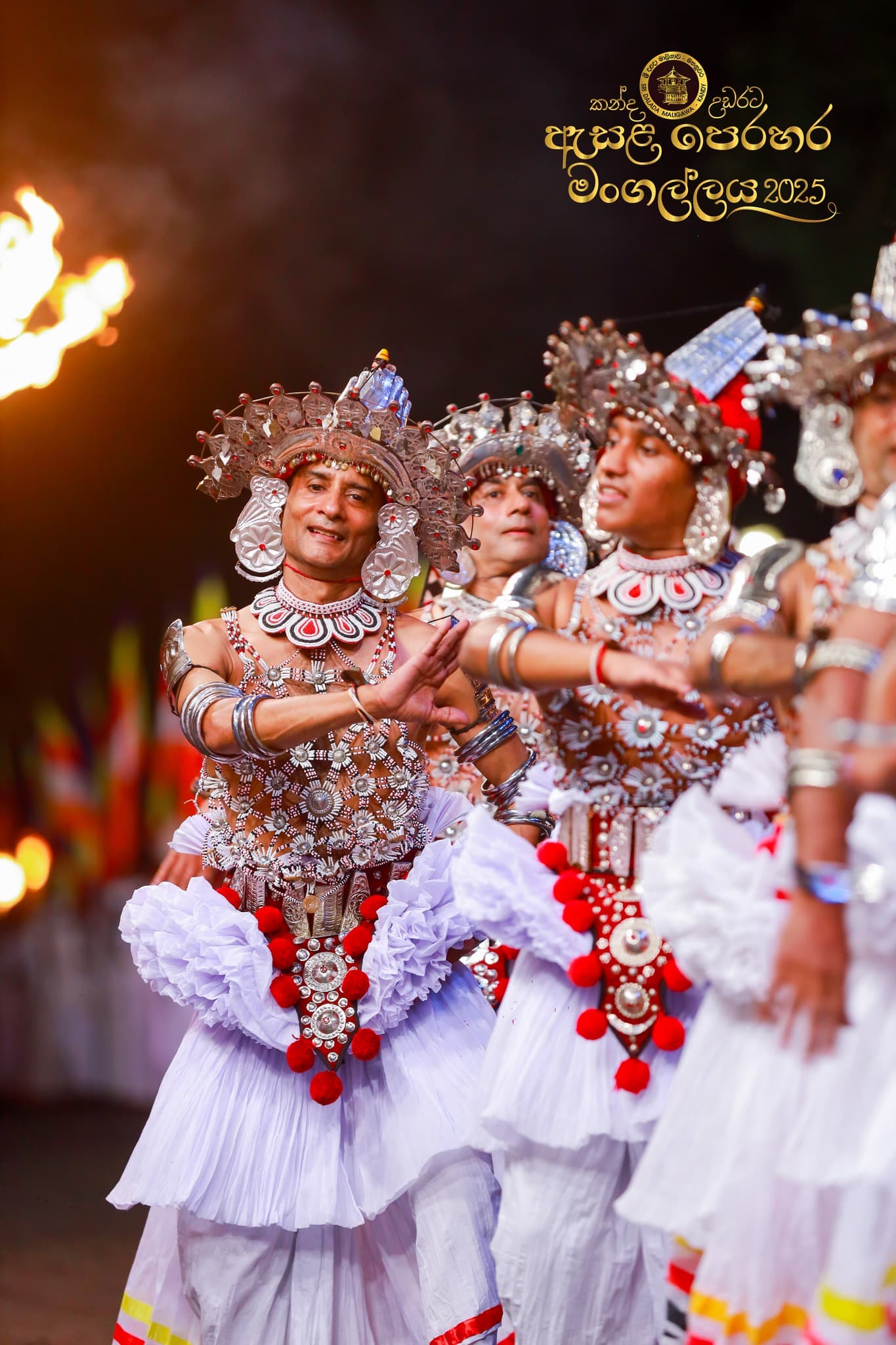
Kandyan dancers in full ceremonial dress — costumes that can weigh over 15kg and take three hours to assemble.
Photo: Sri Dalada Maligawa Facebook Page
The Elephants
Over a hundred elephants walk in the Perahera. Each one is decorated — draped in hand-embroidered costumes, carrying electric lights woven into their coverings, guided by their mahouts who have known them since birth.
The Maligawa Tusker walks at the center. On his back sits the golden casket. Around him, on either side, walk attendants with white cloths ensuring the casket never directly faces the ground.
Foreign visitors almost always say the same thing afterward: they expected spectacle and received something they cannot name. The scale is beyond what the eyes can organize. The sound is beyond what any recording captures. And the devotion — the absolute, unperforming sincerity of everyone around you — is beyond anything most tourists have encountered in a religious context.
This is not a show put on for visitors. Visitors are simply permitted to witness something that would happen exactly the same way if none of them were there.
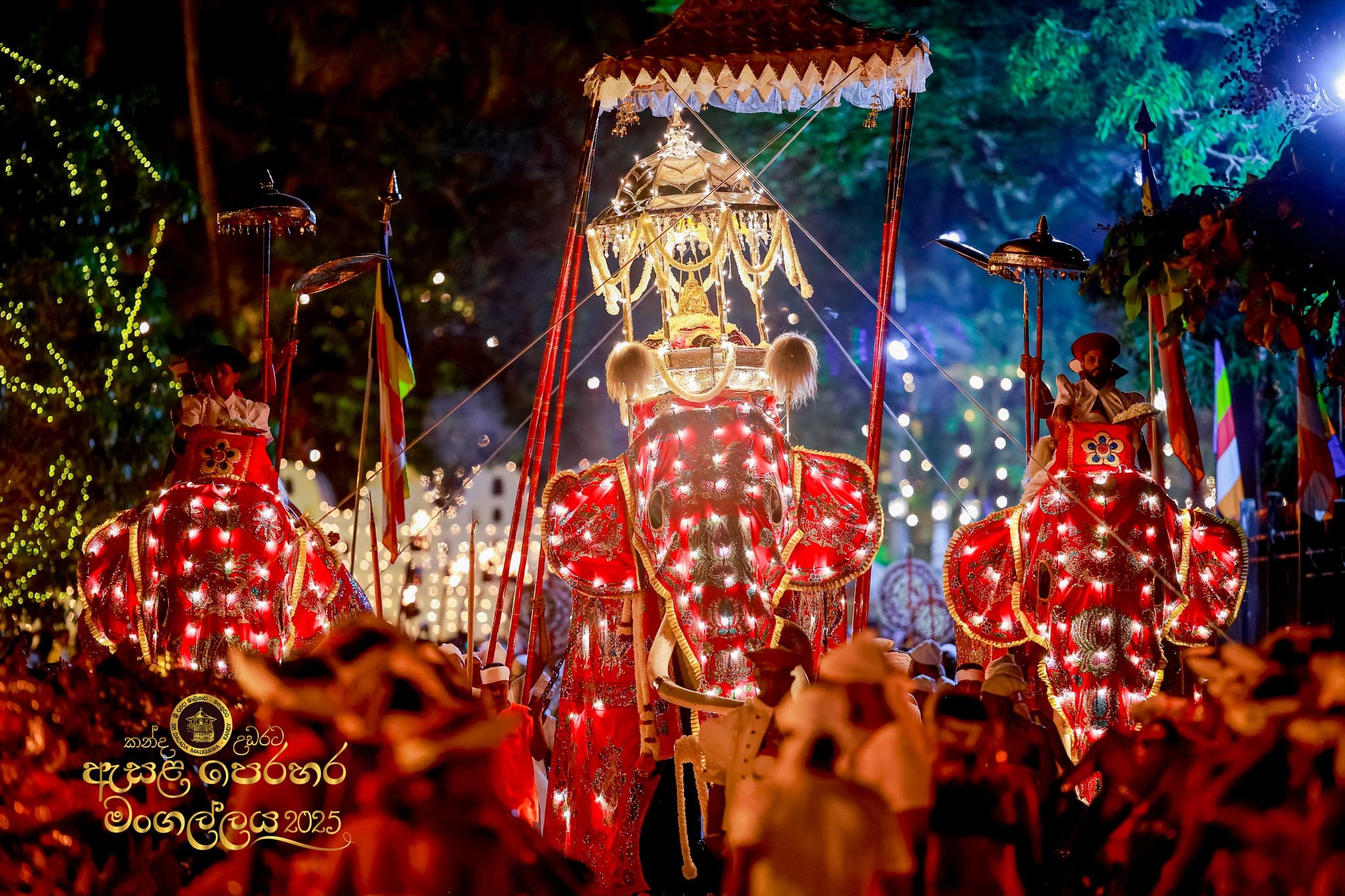
The Maligawa Tusker carries the golden casket — the most sacred role in the entire procession.
Photo: Sri Dalada Maligawa Facebook Page
The History Behind the Fire
The Perahera's origins stretch back to the 3rd century BC, to the arrival of Buddhism in Sri Lanka under King Devanampiya Tissa. The tooth relic itself — said to have been smuggled from India hidden in the hair of a princess — has been the literal symbol of sovereignty on this island for two thousand years. The king who held the Tooth held the right to rule. The Perahera was the annual public declaration of that legitimacy.
Empires rose and fell. The Portuguese came and tried to destroy the relic in 1560 — Sri Lankans will tell you with quiet certainty that what the Portuguese burned was not the real tooth. The Dutch came. The British came. The festival continued through all of it, every single year, without exception.
That continuity is itself the message. The Perahera does not celebrate a historical event. It is the event — an act of civilization renewing itself.
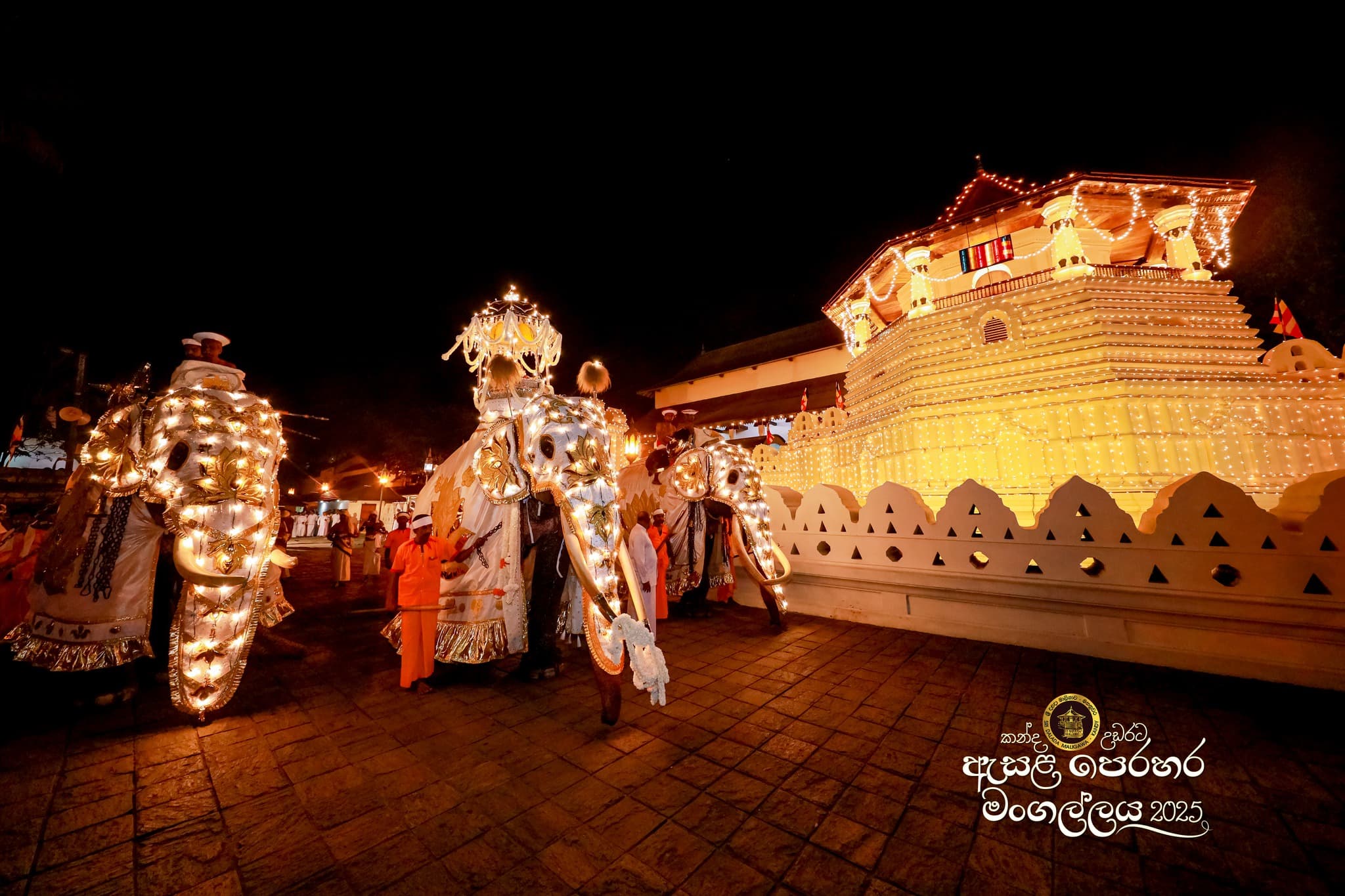
The Sri Dalada Maligawa — Temple of the Sacred Tooth Relic — at night during Perahera season.
Photo: Sri Dalada Maligawa Facebook Page