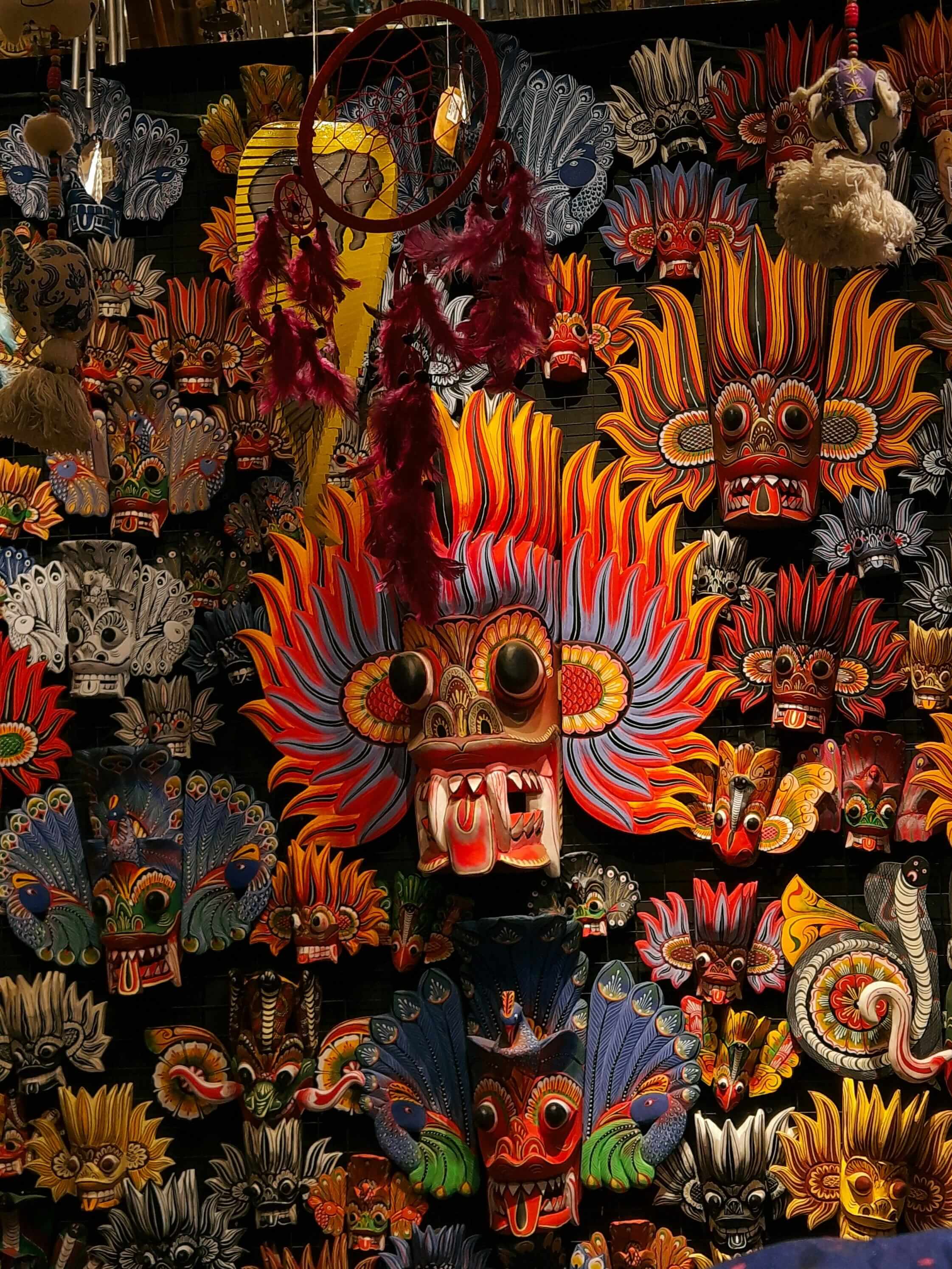
On the southern coast of Sri Lanka, in a town most tourists pass through without stopping, a small number of families are keeping alive a craft that is simultaneously an art form, a medical system, a theatrical tradition, and a spiritual practice. There are fewer than a dozen master carvers left. Each mask they make has been made the same way, by the same family lineages, for over a thousand years. When the last of them stops carving, something genuinely irreplaceable will be gone.
The Mask Is Looking at You
Not in the way that painted eyes in portraits seem to follow you across a room. In a more specific way — the way something looks at you when it was made to be looked at in return. The eyes of a Sanni mask are wide and slightly asymmetrical. The expression is somewhere between a grimace and a grin. The colors are violent — red, yellow, black, white — applied in patterns that have not changed in centuries because changing them would change the meaning, and the meaning is the point.
Pick it up. It is lighter than it looks. The wood is kaduru — a specific coastal timber chosen not for its hardness but for its lightness and its grain, which accepts the carving knife with a particular responsiveness that the carvers describe, when pressed, as cooperative.
Put it down and it is still looking at you.
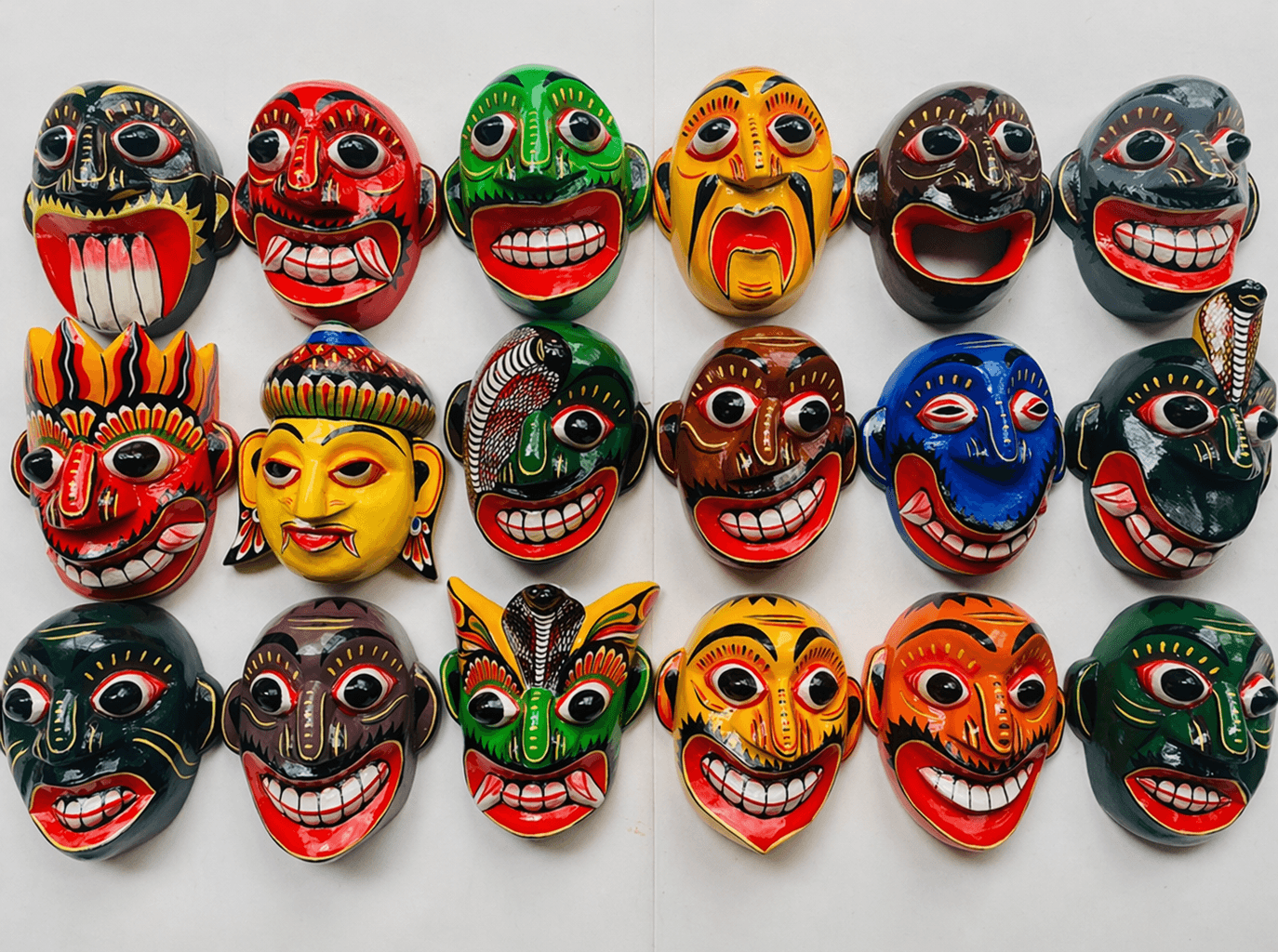
The 18 Sanni demons — each representing a specific category of illness.
What the Masks Are For
The masks of Ambalangoda are not decorative objects. They were not made to hang on walls. They were not made for tourists, though tourists now buy them in large numbers. They were made — and in the hands of the remaining traditional practitioners, are still made — to be worn in ceremony, to embody specific supernatural entities, and through that embodiment to heal.
The tradition has two main branches.
Kolam is a dance-drama form that uses masks to tell stories — originally performed as ritual entertainment at royal courts, later becoming a community festival form. The Kolam masks represent characters from Sri Lankan mythology and social life: kings and queens, demons and deities, animals and archetypes. A full Kolam performance can last an entire night and involve dozens of masked characters moving through a story that the audience already knows, the pleasure being in the performance rather than the narrative.
Sanni Yakuma is something different and considerably older. It is a healing ritual. The 18 Sanni demons — each representing a specific category of illness, from fever to blindness to mental disturbance — are summoned by a masked dancer, given form and voice, confronted, appeased, and sent away. The patient sits at the center. The demon is danced into presence around them. The theory — which has coexisted peacefully with Ayurvedic and eventually modern medicine for centuries — is that illness has a supernatural dimension that must be addressed alongside its physical one.
The masks used in Sanni Yakuma are among the most powerful objects in the tradition. They are not sold. They are not displayed. They are kept by the ritual practitioners who use them and treated as what they are — active participants in a ceremony, not representations of one.
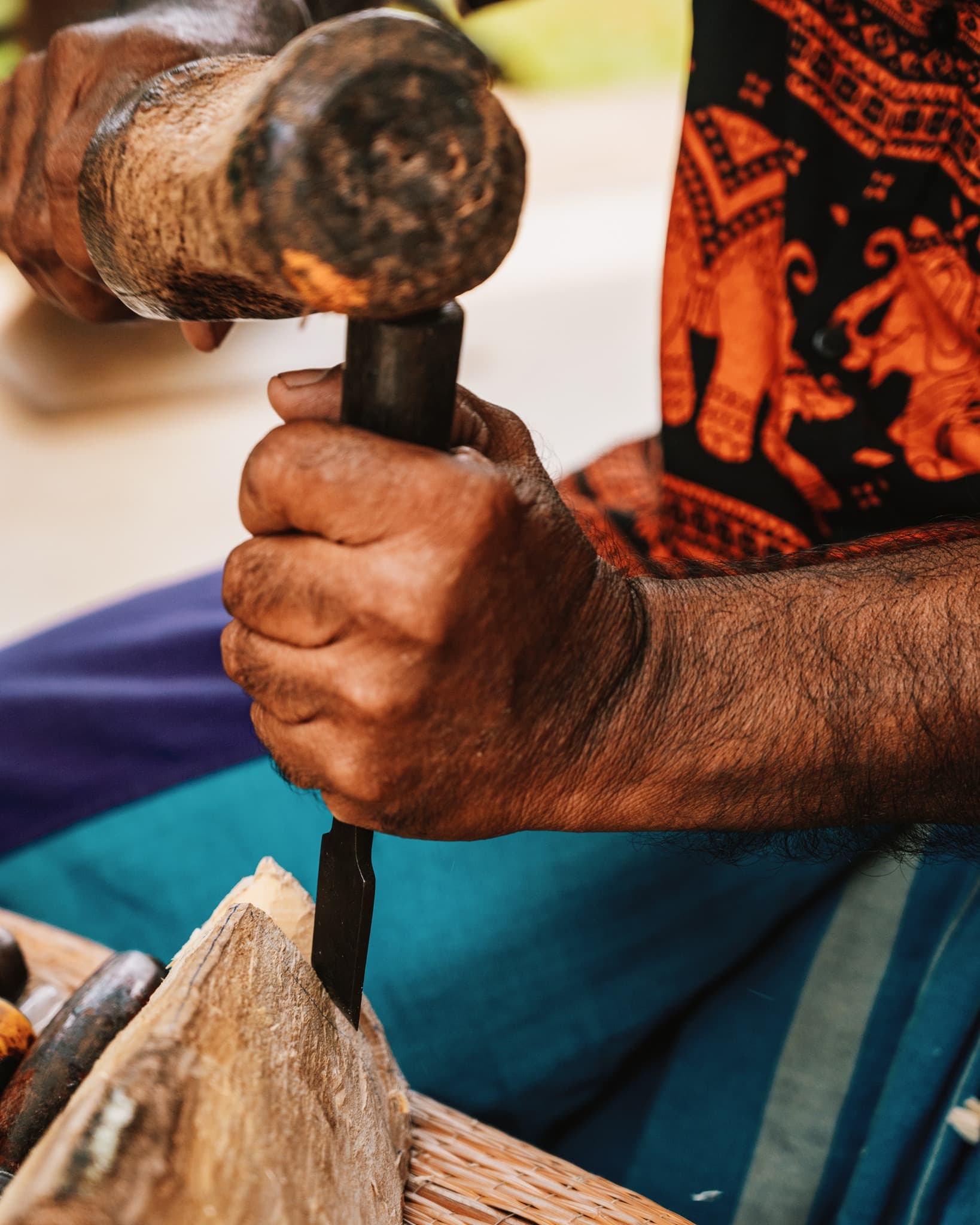
Master carver at work — decades of practice in every cut.
The Town of Ambalangoda
Ambalangoda sits on the southwestern coast, about ninety kilometres south of Colombo and thirty kilometres north of Galle. It is a working coastal town — fishing boats, a market, the particular rhythm of a place that has been doing the same things for a very long time. The beach is wide and tends toward rough surf. The streets are unhurried.
The mask-carving tradition is concentrated in a specific neighborhood called Ahangama Road and the surrounding streets, where several family workshops have operated for generations. From the outside they look like ordinary houses. Inside, depending on the time of day, you might find a master carver at work, his tools spread on a cloth beside him, a half-finished face emerging from a block of kaduru wood with a patience that makes watching feel like a privilege.
The Ariyapala Museum and Workshop is the most established entry point for visitors — a working studio and small museum run by one of the oldest mask-carving families, where you can see finished masks alongside works in progress and, if you time it right, watch the carving itself. It is not a performance of craft for tourist consumption. It is a working studio that happens to receive visitors.
The distinction matters. What you are watching is not a demonstration. It is the thing itself.
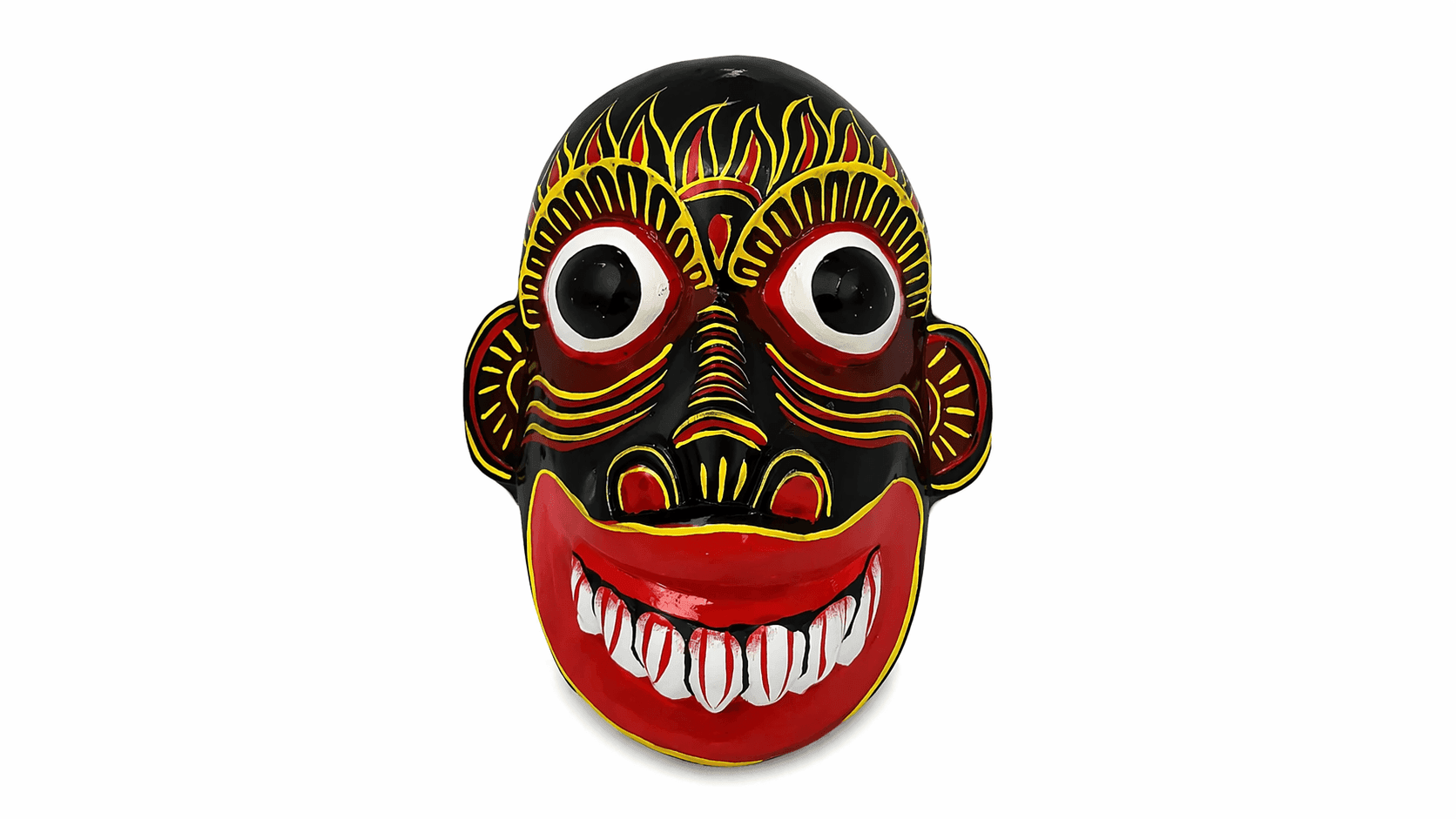
A finished Sanni mask — centuries of tradition in every carved detail.
The 53 Characters
The full traditional repertoire of Ambalangoda masks covers 53 distinct characters — 18 Sanni demons, a set of Kolam characters, and various subsidiary figures. Each has a fixed appearance that cannot be altered without changing its ritual identity. The color of a specific demon's face, the shape of its crown, the expression of its eyes, the number and arrangement of its teeth — all of these are prescribed by a tradition that was already old when it was first written down.
This fixity is not conservatism for its own sake. It is functional. A Sanni Yakuma practitioner receiving a mask from another carver needs to be able to identify immediately which demon he is holding. The mask is a tool. Its standardization is what makes it usable across different practitioners, different regions, different generations.
The carvers are not artists in the contemporary sense — individuals expressing personal vision. They are craftsmen in the older sense — individuals executing, with maximum skill, a received form. The creativity is in the execution, in the quality of the carving and the vitality of the expression within the fixed parameters, not in departing from them.
What separates a master carver from a competent one is visible immediately to anyone who has seen both. The master's masks have something the competent carver's masks do not — a quality of presence, of being looked at that the best of them have in abundance — and that quality is the product of decades of practice within a tradition, not departure from it.
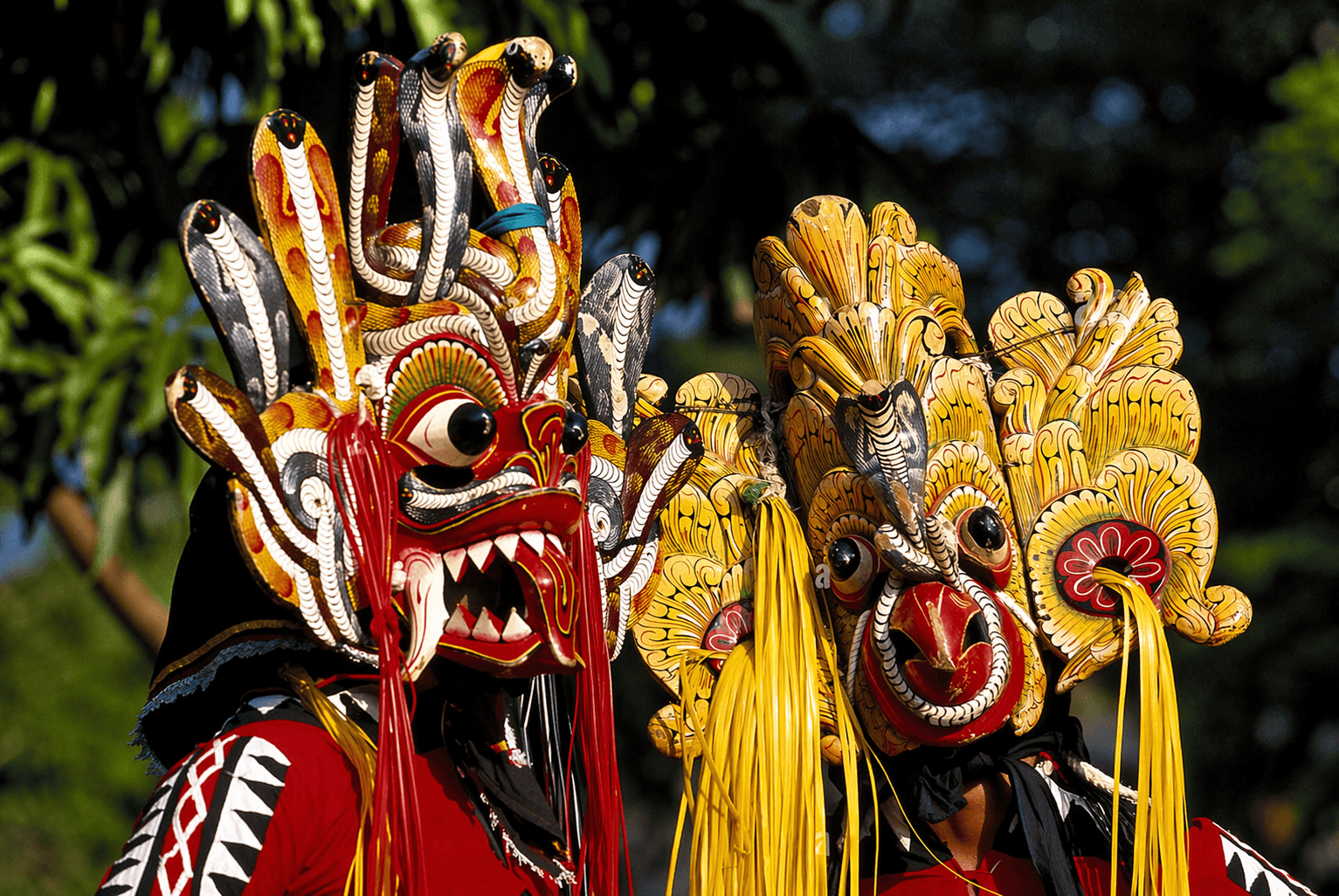
Kolam dance — when the mask becomes alive through performance.
What Is Being Lost
The honest version of this story includes what is happening to the tradition.
The ritual context that gave the masks their original purpose has contracted significantly. Sanni Yakuma ceremonies are still performed, but less frequently and in fewer communities than a generation ago. The Kolam dance-drama tradition survives primarily in cultural performances rather than the all-night community festivals it once was. The masks continue to be made in large numbers — Ambalangoda produces thousands of them annually for the tourist and export market — but the majority are made quickly, in simplified versions, for decorative sale rather than ceremonial use.
The master carvers who maintain the full traditional repertoire, who can make all 53 characters to the prescribed specifications and understand the ritual context of each one, are elderly. Their students are fewer than their teachers were. The economic pressures that have always pushed craft traditions toward simplification for the market have not eased.
What is specifically at risk is not the mask as object — versions of these masks will be made and sold for the foreseeable future. What is at risk is the knowledge: the understanding of why each character looks the way it does, what ritual function it serves, how the ceremony it participates in works and what it is meant to accomplish. That knowledge lives in specific people. It is not fully written down. When those people are gone, the written record will be incomplete.
Visiting Ambalangoda
Getting there
Ambalangoda is on the coastal railway line between Colombo and Galle. The journey from Colombo takes approximately two hours by express train. From Galle it is thirty minutes. The town is walkable from the station.
The Ariyapala Workshop
Open most days during daylight hours. No appointment needed for a general visit, but if you want to watch active carving or speak with a senior carver, contact ahead and visit on a weekday morning. The museum section covers the full 53-character repertoire with explanatory panels.
What to buy
If you are buying a mask, buy it from the family workshops rather than the roadside stalls. The price is higher and the difference in quality and authenticity is significant. A mask made by a master carver to traditional specifications is a different object from a simplified tourist version, and the carver's livelihood depends on that difference being understood.
What to ask
Ask to see the full Sanni set if it is available. Ask about the ritual function of specific characters. Ask how long the master has been carving and who taught him. The carvers are not performers, but most will speak, quietly and with evident knowledge, about what they do and why it matters — if they are asked with genuine curiosity rather than tourist efficiency.
Why This Matters to a Visitor
There is a version of cultural tourism that treats traditions like this as entertainment — colorful, photogenic, safely exotic. That version misses the point entirely.
The masks of Ambalangoda represent something that most modern societies have lost and cannot recover: a coherent system in which art, medicine, spirituality, and community ritual are not separate categories but a single practice. The Sanni Yakuma ceremony does not distinguish between the patient's body, the patient's mind, and the patient's relationship with the supernatural. It treats all three simultaneously, with a masked dancer as the instrument of treatment.
Whether you believe in the efficacy of that treatment is, in some ways, beside the point. What matters is that this system existed, was refined over centuries into something of great sophistication and beauty, and is now held in the hands of a very small number of people in a coastal town in southern Sri Lanka.
Going to Ambalangoda and sitting with one of those carvers for an hour — watching the knife move through the kaduru wood, asking the questions that occur to you, buying a mask made by hands that know what the mask is for — is an act of witness. It keeps the knowledge visible. It gives the carver a reason to keep carving.
It is a small thing. It is also exactly the right thing to do.