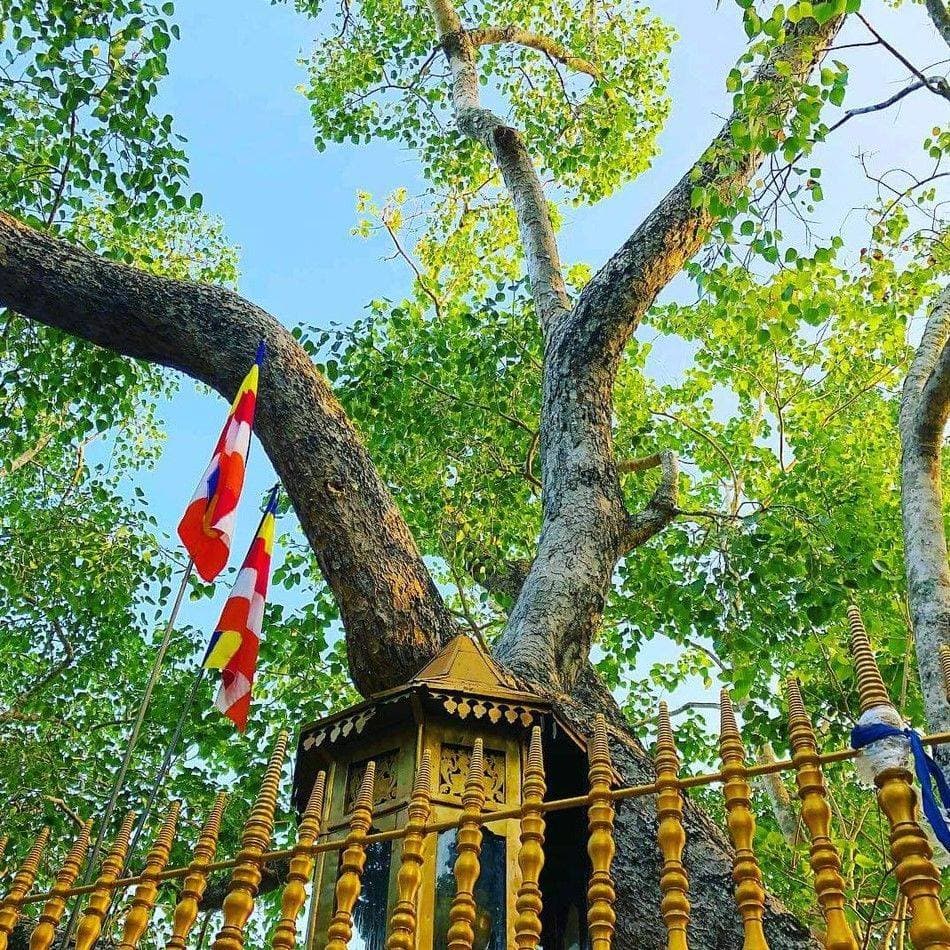
In the ancient city of Anuradhapura, surrounded by the ruins of a civilization that no longer exists, a tree is being watered this morning. It was being watered yesterday. It has been watered every single morning for two thousand three hundred years. The people doing the watering consider this the most important task on earth.
It Does Not Look Like the Oldest Thing
That is the first surprise. You expect something gnarled and dramatic — a tree that announces its age visually, that looks like it has survived centuries. The Sri Maha Bodhi is instead quiet. Its branches spread wide and low, supported now by golden pillars because age has made them heavy. Its leaves are ordinary. Its bark is unremarkable.
And then someone tells you that this tree was already five hundred years old when the Roman Empire was at its height. That it was already a thousand years old when the first European set foot in the Americas. That it has been alive, continuously, since 288 BC — and that in all that time, not a single morning has passed without a human being arriving to tend it.
The ordinariness disappears immediately.
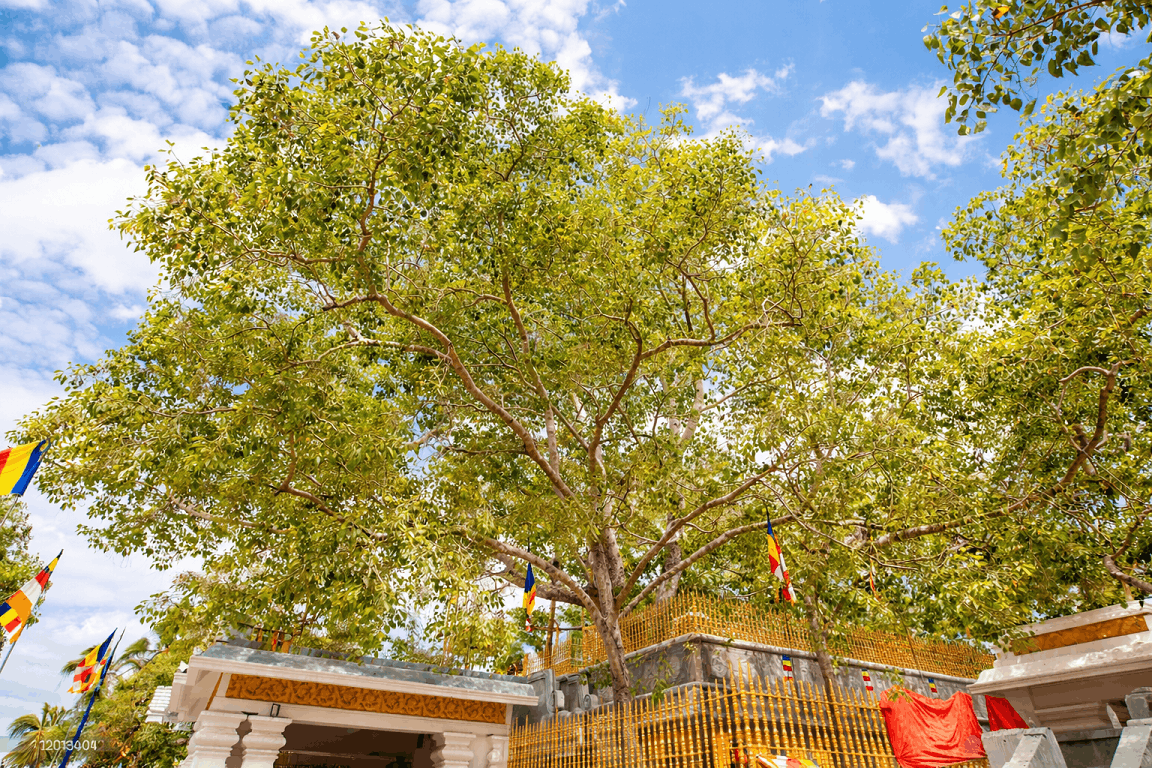
The Sri Maha Bodhi — supported by golden pillars, alive and tended for 2,300 years.
Where It Came From
The story of the Sri Maha Bodhi begins not in Sri Lanka but in India, under a different tree — the Bodhi tree in Bodh Gaya, beneath whose branches the Buddha is said to have attained enlightenment.
In the 3rd century BC, the Emperor Ashoka of India converted to Buddhism after witnessing the devastation of his own military conquests, and devoted the rest of his reign to spreading the Buddha's teachings across Asia. He sent his own daughter, the nun Sanghamitta, to Sri Lanka carrying a branch — some accounts say the southern branch — of the original Bodhi tree in Bodh Gaya.
She arrived by ship. The branch was received by King Devanampiya Tissa with a ceremony that, by the accounts preserved in the Mahavamsa, involved the entire population of Anuradhapura coming to the shore. The branch was planted in the royal pleasure garden. It took root.
That tree — grown from that branch, of that original tree, under which the Buddha sat — is the Sri Maha Bodhi. It is the oldest human-planted tree on earth for which there is a verifiable, documented, unbroken historical record.
The original tree in Bodh Gaya was destroyed centuries ago. The Sri Lankan branch outlived its parent.
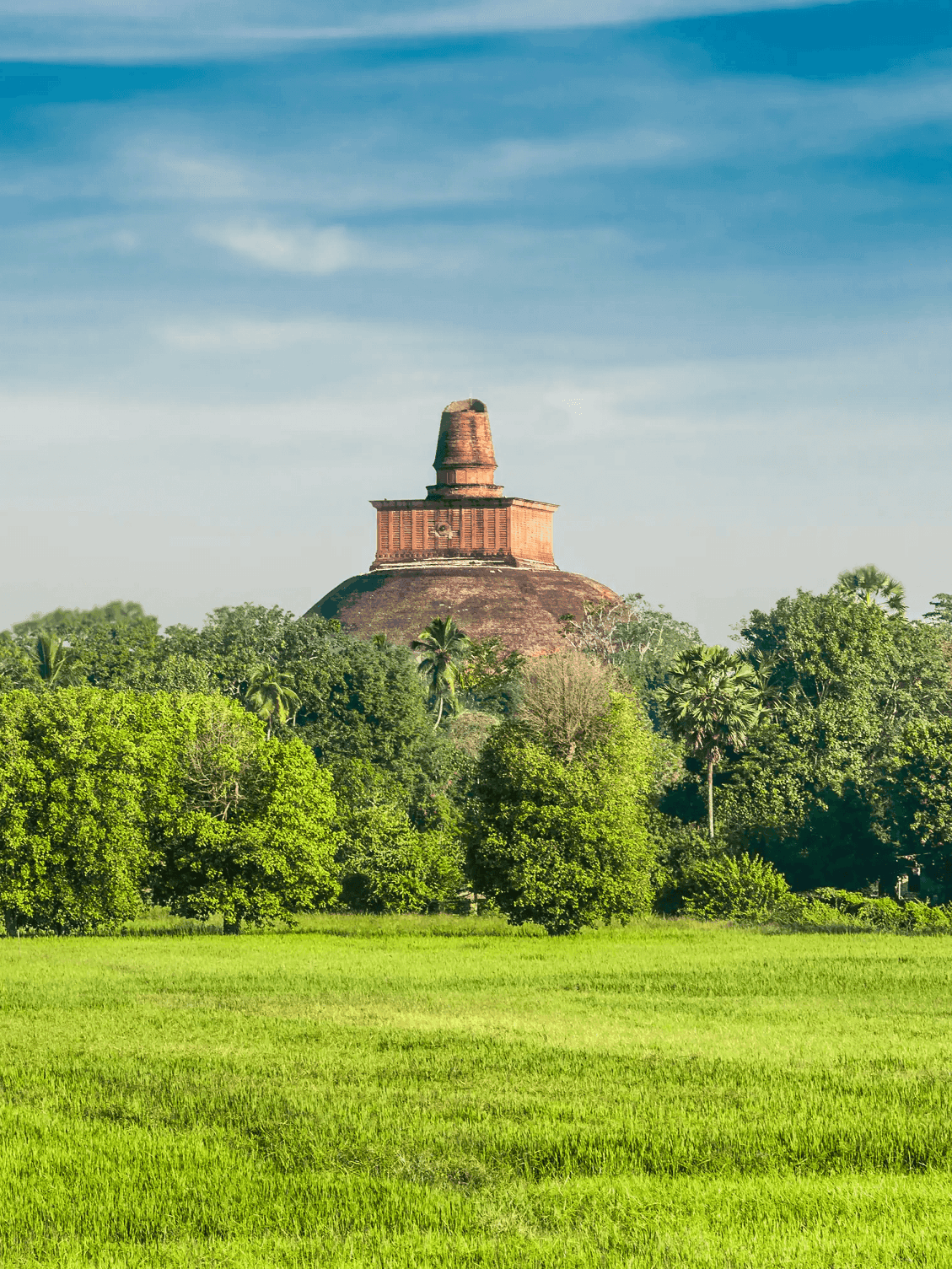
The great dagobas of Anuradhapura rise above the jungle — monuments to a vanished civilization.
The City That Grew Around It
Anuradhapura was the first capital of Sri Lanka — a city that was continuously inhabited and politically significant for over a thousand years, from roughly the 4th century BC to the 10th century AD. At its height it was one of the largest cities in the ancient world, home to hydraulic engineering sophisticated enough to irrigate an entire civilization, and to Buddhist monuments — dagobas — so massive that they rival the pyramids of Egypt in volume.
The city was eventually abandoned after repeated invasions from southern India, its population retreating south, its monuments swallowed slowly by jungle. For centuries it was largely forgotten by the outside world.
The tree was never abandoned.
While the palaces crumbled and the reservoirs silted and the jungle reclaimed the streets, a continuous line of custodians maintained the Sri Maha Bodhi. Kings who no longer had a city to rule still funded its care. Monks whose monasteries had been destroyed still arrived each morning. The tree outlasted every institution that had been built to serve it, and continued to be served anyway.
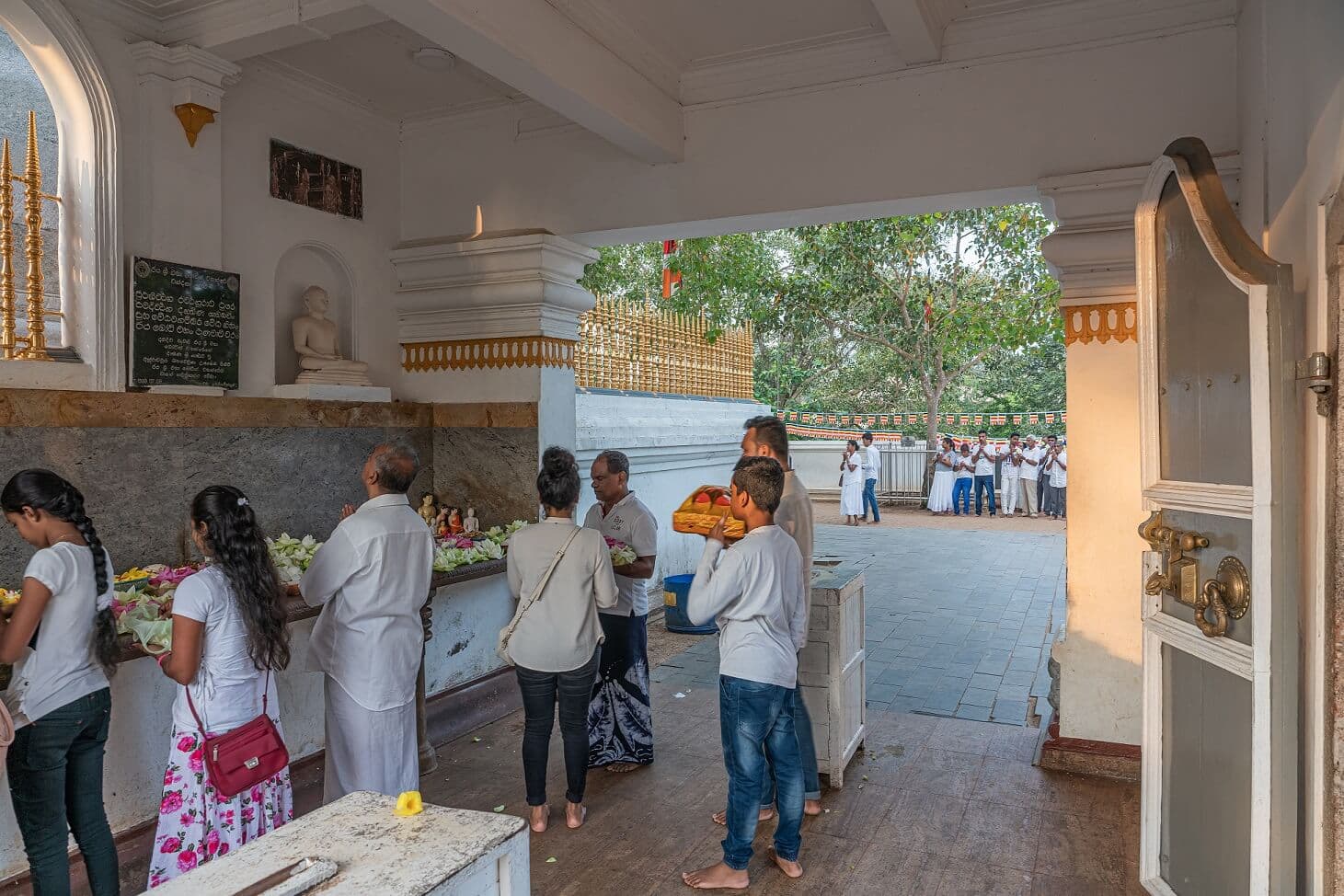
Pilgrims making offerings beneath the Sri Maha Bodhi — flowers, incense, silence.
What You Find There Now
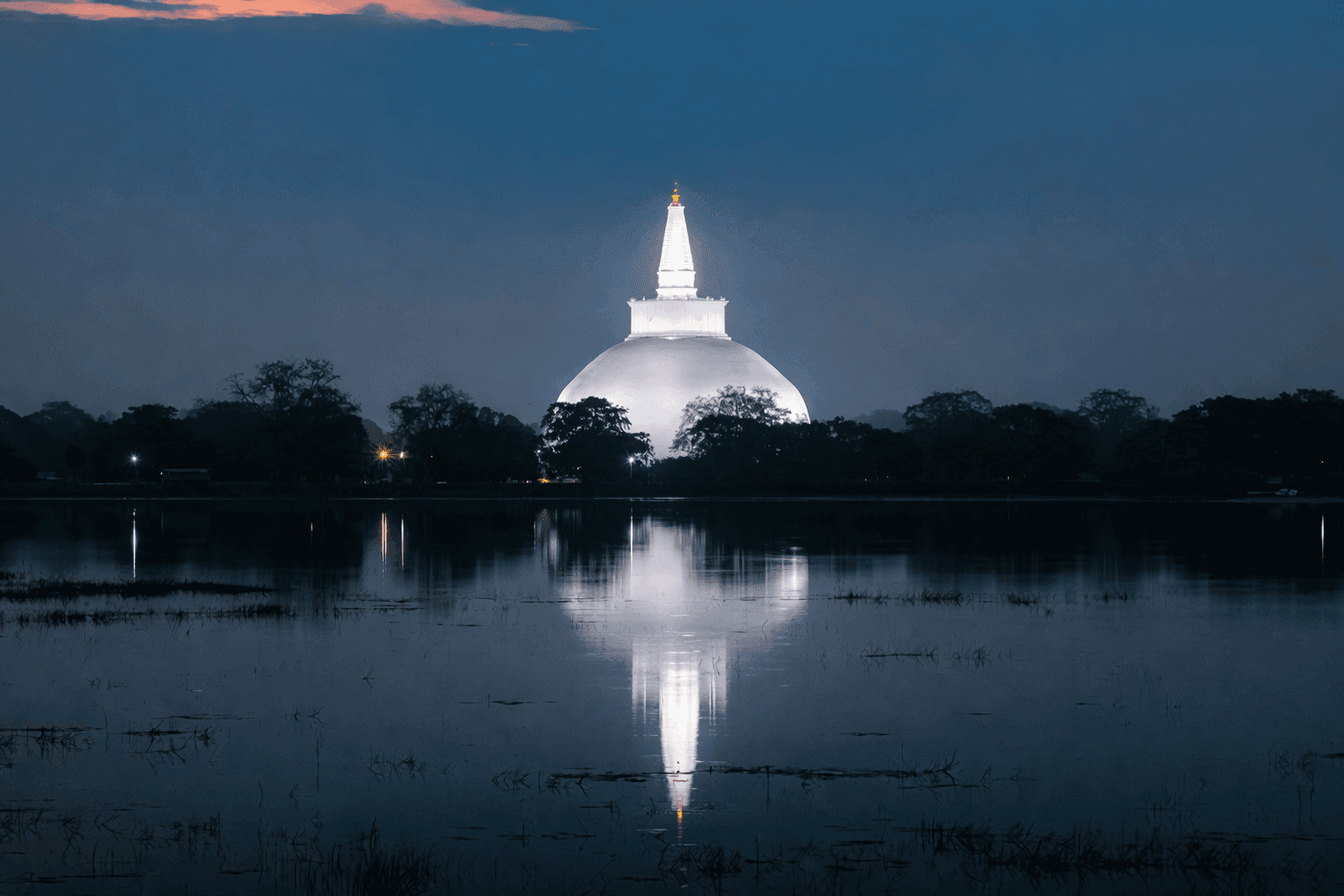
Anuradhapura today is an extraordinary place — a working archaeological site and an active pilgrimage destination simultaneously. The ruins of the ancient city extend for miles. The great dagobas — Ruwanwelisaya, Jetavanaramaya, Abhayagiri — have been partially restored and stand as white domes above the treeline, visible for kilometers in every direction.
The Sri Maha Bodhi sits within a walled temple complex in the southern part of the ancient city. The approach is simple and unhurried — you remove your shoes at the outer gate and walk across warm stone toward the enclosure where the tree stands on a raised platform.
What strikes most visitors immediately is the atmosphere. This is not a tourist site with a sacred object at its center. It is a sacred site that tourists are permitted to visit. The difference is felt immediately in the behavior of everyone around you — the quiet, the purposefulness, the total absence of performance.
Monks meditate beneath the branches. Families make offerings in complete silence. Children sit cross-legged on the warm stone, watching. You can sit here too. Nobody will hurry you.
Dawn over Anuradhapura — ancient reservoirs and the silhouettes of forgotten kings.
The Attack That Failed
In 1985, during the darkest years of Sri Lanka's civil conflict, a group of gunmen entered the Sri Maha Bodhi complex during a busy visiting period and opened fire on the pilgrims gathered there. Over 140 people were killed in one of the most devastating attacks of the entire war.
The tree was undamaged.
Within days, pilgrims were returning. Within weeks the numbers had returned to normal. The attack was intended, among other things, to strike at the symbolic heart of Sinhalese Buddhist identity. What it produced instead was a quiet demonstration of exactly what the tree represents — that it has survived everything before, and will survive everything after.
The custodians arrived the next morning, as they always do, and watered it.
How to Experience It
When to visit
Anuradhapura rewards an early start. Arrive at the Sri Maha Bodhi before 7am when the morning puja fills the enclosure with offerings, incense and chanting. The light at this hour is also extraordinary.
What to wear
White clothing is customary and deeply appreciated. Cover all limbs. Remove shoes at the outer gate and carry them — the complex is large and you will be barefoot throughout.
How long to spend
The tree itself can be visited in an hour. But Anuradhapura deserves a full day — the three great dagobas, the Isurumuniya rock temple, the ancient reservoirs, and the museum all reward time.
Getting there
Anuradhapura is roughly four hours by road from Colombo, or accessible by train. Stay overnight in the town to allow an early morning visit — the site at dawn, before tour groups arrive, is among the finest experiences Sri Lanka offers.
What to bring
Silence, mostly. And a small offering of white flowers if you wish — these are sold at stalls outside every gate and their presence in your hands will communicate something to everyone around you that no guidebook can.
What Two Thousand Three Hundred Years Feels Like
There is a particular quality to very old things that have been continuously cared for — as opposed to old things that have simply survived neglect. The Sri Maha Bodhi has that quality in abundance.
It is not preserved. It is not maintained. It is tended — which is a different thing entirely. Tending implies relationship. It implies that the thing being cared for matters to the person doing the caring, not as a historical artifact but as a living presence that makes demands and deserves attention.
Stand beneath the Sri Maha Bodhi on any ordinary morning and you are standing in the middle of the longest unbroken human relationship with a single living thing that exists anywhere on earth. The monks who water it this morning are the direct continuation of the monks who received it from Sanghamitta's hands in 288 BC.
That is not a metaphor. That is simply what happened, every morning, without exception, for two thousand three hundred years.